• About
    arrow_drop_down
    • SDGsTracker
      arrow_drop_down
      • Background
      • Methodology
      • Launch Events
    • Team
    • Contact Us
  • Countries
    arrow_drop_down
    • Search All
  • World Progress
    arrow_drop_down
    • Overall SDGs
      arrow_drop_down
      • Achieved
      • On-Track
      • Moderately Off-Track
      • Off-Track
      • Severely Off-Track
      • No Progress
    • Individual SDGs
    • World Ranking
  • Challenges
  • Contribution
  • Lessons Learned
  • Impact
  • Interactive Maps
Sign in or Register

Iraq

  • Send an email
  • Other Countries
  • Overview
  • SDGs Progress
  • Challenges
  • Lessons Learned
  • Contribution
  • Experts
  • Universities
  • Events
  • Video
  • prev
  • next
  • prev
  • next
Overview

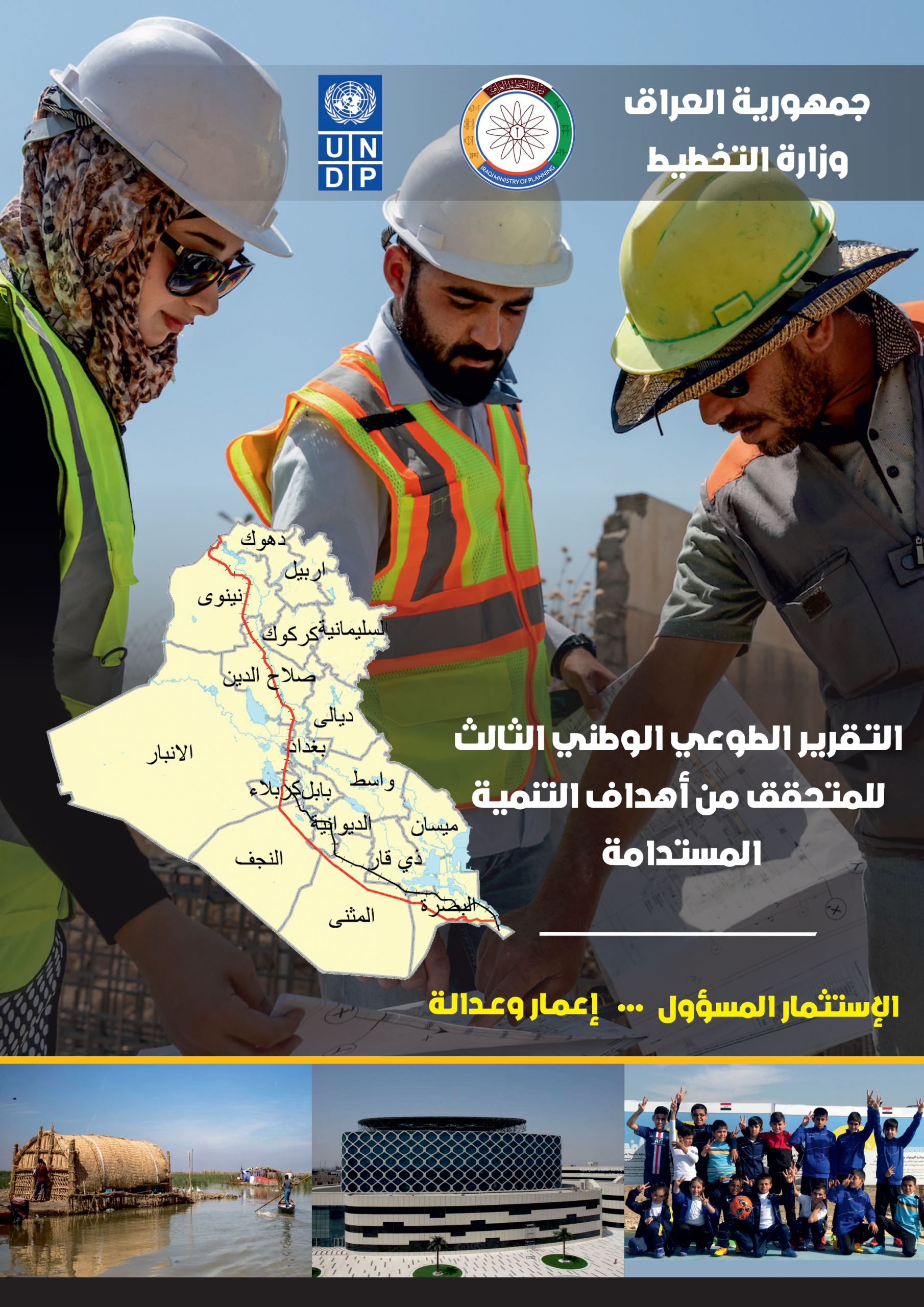
Iraq’s third Voluntary National Review (VNR), submitted in 2025, presents a comprehensive assessment of the country’s progress towards the Sustainable Development Goals (SDGs) amid years of crisis. Following the war against terrorist groups, political instability, and the triple shock of the COVID-19 pandemic and oil price collapse, Iraq faced major setbacks in poverty reduction, education, and healthcare. Despite these challenges, the report conveys a narrative of resilience, centred on “Responsible Investment, Reconstruction and Justice.” It highlights renewed optimism and Iraq’s commitment to aligning national recovery with global sustainability frameworks, including the Paris Agreement and regional reconstruction partnerships.

Recommendations

  1. Strengthen Economic Diversification and Private Sector Development: Reducing dependence on oil is crucial for sustainable growth. By expanding sectors such as agriculture, manufacturing, tourism, and renewable energy, and supporting SMEs and youth-led enterprises with regulatory reforms and improved access to finance, the economy can become more resilient. Vocational and technical training aligned with market needs will further enhance workforce employability, while public–private partnerships can drive strategic infrastructure and industrial development.
  2. Address Regional and Rural Inequalities: Targeted strategies are needed to reduce poverty and regional disparities. By focusing on underdeveloped southern and rural governorates, investing in infrastructure, and strengthening social protection systems, vulnerable populations including women, children, displaced persons, and people with disabilities can access improved opportunities. Localised development planning ensures that interventions are tailored to the unique needs of each region.
  3. Advance Human Development through Health, Education, and Gender Equality: Investing in health and education is essential for inclusive development. Modernising curricula, expanding digital learning, and promoting equitable distribution of services reduce dropout rates and improve quality. Women’s economic empowerment can be strengthened through inclusive employment policies and entrepreneurship support, while domestic healthcare production and supply chain resilience enhance access to essential medicines.
  4. Enhance Environmental Sustainability and Climate Resilience: Sustainable growth requires strong environmental stewardship. Implementing the National Environmental Protection Strategy, integrating renewable energy, and developing climate adaptation plans address challenges such as droughts, desertification, and water scarcity. Strengthened water management and waste control systems promote sustainable consumption and resource preservation.
  5. Strengthen Governance, Institutional Reform, and Anti-Corruption Measures: Effective governance is central to long-term stability. Deepening judicial and administrative reforms, expanding e-governance, and empowering local governments improve accountability and service delivery. Participatory decision-making ensures inclusive policy planning and strengthens citizen trust.
  6. Build Robust Data and Monitoring Systems: Reliable data underpins informed policymaking. Enhancing national statistical capacity, investing in digital infrastructure, and collaborating with international partners improves data quality and analytical capacity. Regular SDG progress reporting ensures transparency and evidence-based decision-making.
  7. Mobilise Sustainable Financing and Partnerships: Sustainable financing is key to achieving development goals. Diversifying funding sources, promoting responsible investment, and leveraging strategic partnerships support innovation, capacity-building, and job creation. A national SDG financing framework ensures coordinated spending and effective resource allocation.
  8. Strengthen national statistical systems to systematically measure, monitor, and report progress across all 17 SDGs and 234 performance indicators. Iraq should provide transparent evidence detailing which of the indicators have been achieved, alongside data-supported analyses of those still in progress. This will ensure greater accountability, facilitate peer learning, and guide policy adjustments towards the 2030 Agenda.

Conclusion

Iraq’s 2025 VNR reaffirms the nation’s strong commitment to the 2030 Agenda, demonstrating resilience amid post-conflict recovery and economic shocks. Grounded in “Responsible Investment” and a focus on reconstruction and justice, Iraq has achieved notable progress, including reducing poverty from 20.05% in 2018 to 17.5% in 2023 and increasing life expectancy from 58 years in 2010 to 74.9 years in 2024. Yet, the report candidly recognises major challenges persistent regional inequalities, limited economic diversification, rapid population growth, and severe environmental pressures. Looking ahead, Iraq aims to strengthen data systems, governance, and institutional capacity while enhancing partnerships and financing. With continued reform and inclusive participation, Iraq can consolidate its progress, but without urgent action on diversification, governance, and climate adaptation, falling short of its 2030 goals.
SDGs Progress Tracker
  • SDGs Completion % 54
  • SDGs On-Track % 6
  • SDGs Achieved % 0
Voluntary National Reports

Country Focal Point
  1. Dr Maher Hammad Johan
    Deputy Minister / Ministry of Planning
    Cell Phone: 00964-781-308-4606
    Irag - Baghdad-Ministry of Planning- Karada MAriam - close to Al-Jumhuria Bridge
  2. Ms Aseel Adel
    Director of the Sustainable Development Department at the Ministry of Planning of Iraq
Location

Ministry of Planning, Karada MAriam, Close to Al-Jumhuria Bridge, Baghdad, Iraq

Get Directions
Region
  • MENA
  • Iraq
No Poverty
Score:3
Justification Poverty declined from 20.05% (2018) to 17.5% (2023). However, rural southern provinces still record poverty rates above 30%, showing uneven progress.
Challenges Stark regional disparities, with poverty exceeding 30% in rural southern areas.

Despite progress, poverty remains high in several governorates, particularly in rural southern areas, indicating uneven progress in poverty reduction

Progress

/Solution

National poverty rate declined from 20.05% (2018) to 17.5% (2023); implementation of successive Poverty Reduction Strategies
Unsolved Challenges Need for more targeted, data-driven social protection and sustainable livelihood programmes.
Zero Hunger
Score:2
Justification The government has increased cereal production and improved seed quality, but the VNR provides no data on malnutrition or stunting. Lack of evidence on food security outcomes justifies a lower score.
Challenges Droughts and water scarcity threaten food production and rural livelihoods.
Progress

/Solution

Food assistance and agricultural recovery programmes continue; emphasis on rural development.
Unsolved Challenges Weak agricultural infrastructure and limited investment in climate-resilient farming.
Good Health
Score:3
Justification Life expectancy increased from 58 years (2010) to 74.9 years (2024). Gains in primary healthcare and vaccination are noted, though per capita spending remains below regional averages.
Challenges Health spending remains below regional averages; inequities across provinces.

Economic Dependence: Iraq still produces only 10% of its pharmaceutical needs, revealing dependency on imports and limited local production capacity in the health sector.

Health Spending: Health expenditure remains low compared to regional standards, affecting access to quality healthcare and medical services.

Progress

/Solution

Health spending remains below regional averages; inequities across provinces.
Unsolved Challenges Insufficient healthcare infrastructure and low per capita health expenditure.


Quality Education
Score:3
Justification Literacy programmes enrolled 74,180 learners (2023/24), but dropout rates remain high and rural-urban disparities persist.
Challenges Overcrowded classrooms, high dropout rates, and regional inequality in education access.
Progress

/Solution

Adult education programmes enrolled 74,180 learners in 2023/24; literacy initiatives ongoing
Unsolved Challenges Need for comprehensive reforms in education quality, infrastructure, and teacher training.
Gender Equality
Score: 3
Justification Women hold 29% of parliamentary seats and 17.5% of senior administrative roles. Despite this, low female labour force participation shows limited progress in economic empowerment.
Challenges Low female labour participation; cultural and institutional barriers persist.

Women’s representation and employment remain limited beyond formal quotas, reflecting ongoing barriers to equality and empowerment

Progress

/Solution

Women hold 29% of parliamentary seats and 3 of 23 ministerial posts; national strategies on gender justice and empowerment.
Unsolved Challenges Limited progress in economic empowerment and leadership opportunities for women.
Water & Sanitation
Score:2
Justification Iraq faces severe water stress from upstream damming and poor management. Few improvements are documented, and access gaps remain significant.
Challenges Drought, pollution, and inadequate infrastructure threaten sustainable water access.
Progress

/Solution

Continued investments in water management and service delivery improvements.
Unsolved Challenges Weak capacity for integrated water resource management and adaptation to scarcity.


Clean Energy
Score:3
Justification Commitments to renewable energy exist, but integration into the grid is minimal, and fossil fuel dependence dominates the energy sector.
Challenges Implementation delays and limited renewable energy integration into the grid.
Progress

/Solution

Commitment to renewable energy and emission reduction projects.
Unsolved Challenges Need for stronger institutional frameworks to expand renewable energy capacity.
Decent Work
Score:3
Justification A national programme to create jobs exists, but unemployment remains high, particularly for youth, and oil dependency limits economic diversification.
Challenges Challenges:

High unemployment, especially among youth and women; weak private sector diversification.

Progress

/Solution

National programmes launched to create jobs and stimulate investment; major projects (Grand Faw Port, Development Road).
Unsolved Challenges Labour market reforms and SME development remain limited.
Industry & Infrastructure
Score:3
Justification Strategic projects (Grand Faw Port, Development Road) are underway, yet industrialisation and innovation indicators remain weak.
Challenges Slow progress in industrial diversification and innovation ecosystems.
Progress

/Solution

Strategic infrastructure projects underway to improve connectivity and logistics.
Unsolved Challenges Need for stronger industrial policy and support for research and technology transfer.
Inequality
Score:3
Justification Regional disparities remain severe, with rural poverty rates high. The Development Achievement Index provides insights but shows persistent inequality.
Challenges Persistent regional and gender disparities; uneven access to services.
Progress

/Solution

Inclusion of marginalised groups in social programmes; governance reforms.
Unsolved Challenges Lack of disaggregated data and comprehensive equality measures.


Sustainable Cities
Score:3
Justification 70.2% of Iraqis live in urban areas (2024 census), and housing loans exceeded 1.6 trillion IQD. However, rapid urbanisation continues to strain infrastructure.
Challenges Rapid urbanisation, housing shortages, and limited urban infrastructure.

Rapid urbanisation (70.2%) places heavy pressure on housing, infrastructure, and service delivery, particularly in major cities.

Progress

/Solution

Investment in sustainable urban housing and city planning; 70.2% urban population (2024).
Unsolved Challenges Need for resilient city planning and improved urban service delivery.
Responsible Consumption
Score:2
Justification References to “green economy” and “responsible investment” exist, but little detail is provided on SCP policies, waste management, or circular economy initiatives.
Challenges Weak enforcement of environmental standards.
Progress

/Solution

Emerging policies on waste management and sustainable production.
Unsolved Challenges Limited awareness and implementation of sustainable consumption frameworks.
Climate Action
Score :1
Justification Iraq is highly vulnerable to climate shocks. Despite adopting the 2024–2030 Environmental Strategy, implementation is weak, renewable energy integration is minimal, and adaptation measures are insufficient.
Challenges Frequent heatwaves, droughts, and sandstorms; low adaptive capacity.

Continued water scarcity, pollution, and desertification threaten sustainable development despite the adoption of a national environmental strategy.

Progress

/Solution

Commitment to Paris Agreement and renewable energy transition.
Unsolved Challenges Insufficient implementation of mitigation and adaptation measures.
Life Below Water
Score :4
Justification No evidence of marine conservation or sustainable fisheries. Port projects are mentioned, but environmental safeguards are absent.
Challenges Water pollution and degradation of aquatic ecosystems.
Progress

/Solution

Recognition of environmental protection needs in national policy.
Unsolved Challenges Absence of comprehensive marine and freshwater protection programmes.


Life on Land
Score:2
Justification Commitments exist to improve resource management, but biodiversity loss, desertification, and weak enforcement undermine progress.
Challenges Desertification, deforestation, and loss of biodiversity due to climate stress.
Progress

/Solution

Government commitment to better resource management.
Unsolved Challenges Weak environmental governance and reforestation efforts.
Peace & Justice
Score:3
Justification Violent crimes declined by 33.1% (2015–2018). Anti-corruption efforts and digitalisation raised satisfaction with services to 96.6%, though gaps remain in rural areas.
Challenges Uneven governance quality and weak institutional capacity in conflict-affected areas.
Progress

/Solution

Improved peace and governance since 2014; anti-corruption reforms; digitalisation raised service satisfaction to 96.6%.
Unsolved Challenges Need for deeper judicial reform and decentralised governance.
Partnerships
Score: 3
Justification Partnerships with UNDP, civil society, and regional actors are strong. However, persistent data gaps limit accurate monitoring of SDG progress.
Challenges Persistent data gaps, weak statistical systems, and limited research capacity.
Progress

/Solution

Strong coordination with UNDP and multi-stakeholder engagement in VNR preparation.
Unsolved Challenges Need for stronger data infrastructure and sustained international cooperation for SDG monitoring.
SDGs World Progress: On-Track
  • SDG14
SDGs World Progress: Moderately Off-Track
  • SDG10
  • SDG1
  • SDG3
  • SDG4
  • SDG5
  • SDG17
  • SDG7
  • SDG9
  • SDG11
  • SDG16
  • SDG8
SDGs World Progress: Off-Track
  • SDG2
  • SDG6
  • SDG12
  • SDG15
SDGs World Progress: Severely Off-Track
  • SDG13
Country Challenges
  1. Economic Volatility and Lack of Diversification: Iraq’s heavy dependence on oil makes its economy highly vulnerable to shocks. The “triple crisis” of political instability, the COVID-19 pandemic, and the oil price collapse exposed this fragility. The VNR stresses the need for economic diversification and responsible investment to create sustainable jobs, particularly for youth.
  2. Persistent Regional and Rural Poverty: Although national poverty rates have declined, deep regional disparities persist. In some southern rural governorates, poverty exceeds 30%. The report calls for targeted, locally tailored poverty reduction strategies to address these inequalities.
  3. Post-Conflict Reconstruction and Security: Recovery from the war against terrorism remains incomplete. While security has improved, displacement, damaged infrastructure, and inadequate housing continue to hinder development in liberated areas, slowing equitable reconstruction.
  4. High Population Growth and Urbanisation: With over 46 million people and rapid urbanisation, Iraq faces mounting pressure on housing, infrastructure, and services. Environmental challenges such as water scarcity, desertification, and air pollution—intensify these urban strains.
  5. Governance and Data Gaps: Weak governance, corruption risks, and limited statistical capacity undermine SDG monitoring and evidence-based policymaking. The VNR highlights the need to strengthen institutions, transparency, and data systems to improve accountability and planning.
World Challenges
  • Lack of Diversification
  • Economic Volatility
  • Regional and Rural Poverty
  • Post-Conflict Reconstruction
  • High Population Growth
  • Unplanned Urbanisation
  • Data Gaps
  • Governance and Coordination
Country Lessons Learned
  1. Multi-Stakeholder Participation: Broad engagement of government, civil society, private sector, and academia strengthened SDG ownership and trust, though data gaps still limit evidence-based policymaking.
  2. Strategic Infrastructure for Development: Mega projects like the Grand Faw Port and Development Road are central to economic diversification and job creation, but their long-term benefits require complementary private sector reforms.
  3. Localisation of Development: Targeted, region-specific interventions are essential to reduce poverty and inequality, especially in southern governorates where poverty exceeds 30%.
  4. Environmental Sustainability: Integrating climate adaptation and resource management into all development planning is vital to address water scarcity, desertification, and climate shocks.
  5. Post-Conflict Reconstruction and Governance Reform: Sustainable recovery requires linking physical reconstruction with governance, justice, and institutional reforms to ensure long-term peace and stability.
World Lessons Learned
  • Multi-Stakeholder Engagement
  • Strategic Partnerships
  • Strategic Infrastructure
  • Environmental Sustainability
  • Post-Conflict Reconstruction
  • Governance
  • Localisation of Development
Country Contribution
  1. 2025: Presentation of Iraq’s Third VNR, demonstrating commitment to SDG monitoring and transparency.
  2. 2025: Development of a partial domestic pharmaceutical industry, producing about 10% of national needs.
  3. 2024: Completion of a national population census, providing updated demographic and urbanisation data (46.118 million people; 70.2% urban).
  4. 2024: Life expectancy rose to approximately 9 years, showing major progress in health outcomes.
  5. 2024: Adoption of the National Strategy for Environmental Protection and Improvement (2024–2030) to strengthen environmental governance.
  6. 2023: National poverty rate reduced to 5% from 20.05% in 2018.
  7. 2023/2024: Expansion of literacy initiatives with 74,180 adult learners
  8. 2021–2023: Gradual increase in health expenditure (from 0% to 2.2% of GDP) and continued support for education.
  9. 2015–2018: Violent crimes declined by 1%, reflecting improved security conditions.
  10. 6 trillion IQD allocated in phase, boosting access to housing and infrastructure.
  11. 29% of parliamentary seats held by women; 5% of senior administrative positions filled by women.
  12. 62% completion rate for the government’s programme and 87% for ministerial executive measures, showing strong institutional follow-through.
  13. 6% public satisfaction with digitalised public services, indicating governance improvement.
  14. 2030 Goal: Iraq targets 80 years’ life expectancy, aligning national objectives with SDG milestones.
World Contribution
  • Digital Transformation
  • Increase Health Expenditure
  • National Strategy for Environmental Protection & Improvement
  • Environmental Sustainability
  • Literacy Initiatives
  • National Population Census
  • Housing Loans
  • Women Empowerment
  • Security

You May Also Be Interested In

European Union

The European Union’s (EU) 2023 Voluntary National Review (VNR) marks a historic milestone as the first…
  • Phone

Brazil

In the VNR report, Brazilians' commitment to the principle of "leaving no one behind" guides decisions and…
  • Phone

South Africa

South Africa's 2024 Voluntary National Review (VNR) reaffirms its commitment to the 2030 Agenda for…
  • Phone

© Sdgstracker

Cart

  • Facebook
  • Twitter
  • WhatsApp
  • Telegram
  • LinkedIn
  • Tumblr
  • VKontakte
  • Mail
  • Copy link